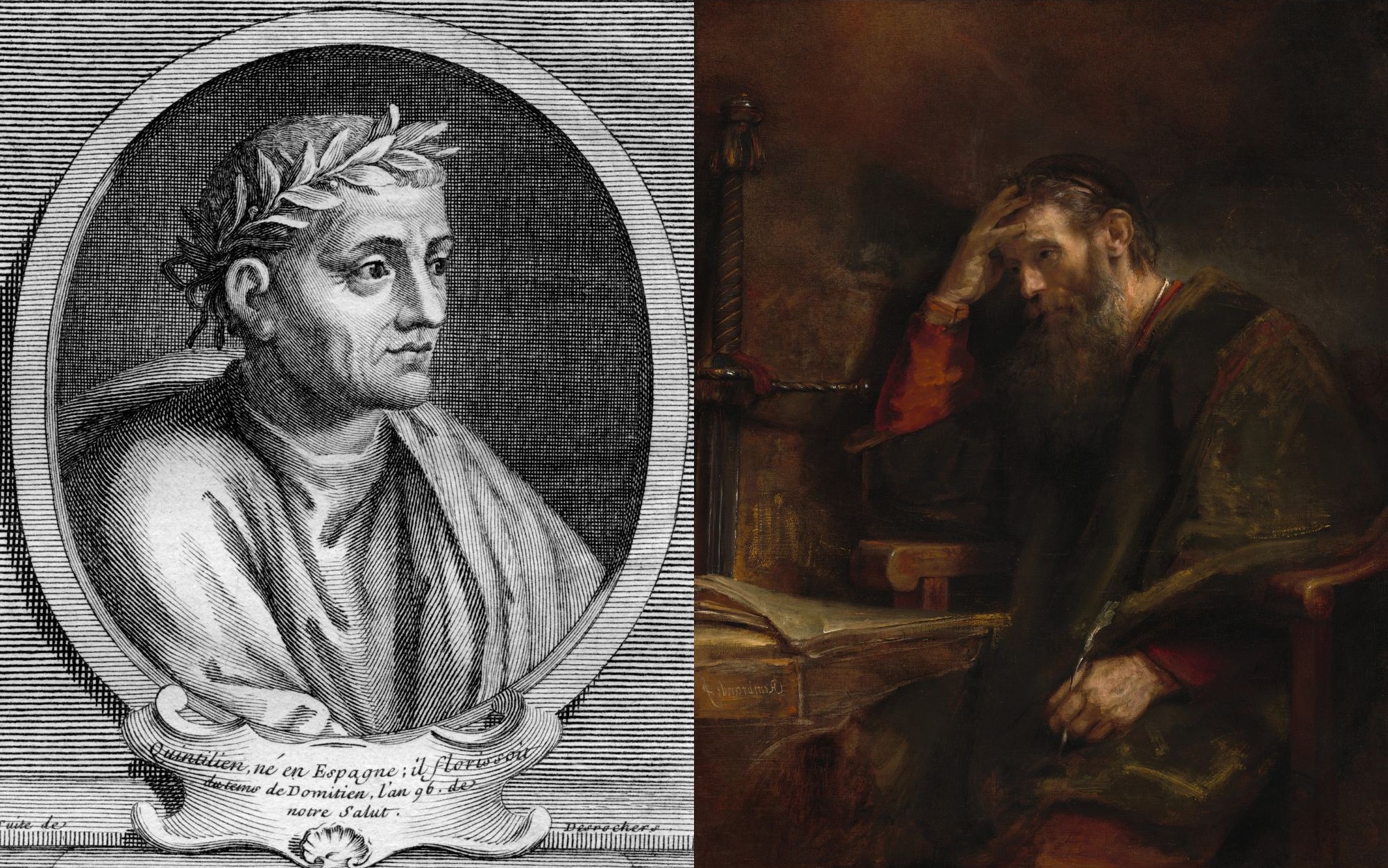
This little Thinkpiece was written for Rhetoric III. It is a fictional dialogue between St. Paul and Quintilian, discussing the use of Pathos in argumentation. It is based on the storyline outlined in Dr. Jim Tallmon’s book, Of Rhetoric and Redemption in La Rioja, which is a great read that I would heartily recommend. This essay is also my first short story, the body coming in at about 1333 words. Being on the shorter side, I couldn’t quite expand themes and whatnot, but here it is. Enjoy!
Karl Lunneborg
Rhetoric III – E26
Fr. Cain
26 March 2026
Thinkpiece #1
“Well,” said Paul, “I thought we might discuss the role of Rhetoric this morning. I see that we have different approaches to how we should use style.”
“Yes, that was something I was thinking about myself,” responded Quintilian. “And I see no reason not to discuss it; other than, I suppose, a desire for breakfast.” Neither of them had gotten up long before.
“I think a good discussion could sustain me, but yes, it would be good to eat. Say we take it out to your veranda.” Paul gestured towards it. “We may eat out there and discuss this.”
“A fine idea.” Quintilian motioned towards an attendant, “Breakfast, please.”
As the attendant left to begin breakfast, Paul and Quintilian walked out to the veranda, each taking seats at the table so that they could see the countryside. Paul began. “So, Quintilian, I understand that your work desires a good use of style and emotion to convince the jury of what is true. Referencing Aristotle, you have the three modes of proof. You know of this. Logos, Ethos, and Pathos. Logos and Ethos are easy for you. You work off the facts of the matter, and you are well known, renowned, even. For me it is the same. Writing my works, I use the facts to teach the people. And I, likewise, am well known. Sometimes too well known for my liking, but I digress.” He gestured to show he was still imprisoned in one way or another, smiling. Quintilian laughed. “But Pathos is where we differ. Pathos, as you know, is the emotion the speaker uses and the emotion he evokes from his listeners. When I teach, I have found that too much Pathos does two things. First, it hides your point. Buried in emotion and feelings, the Truth is hidden, and there’s no use in the teaching. Secondly, people will begin to realize that you are using a lot more Pathos than anything else. As you probably know from listening to a defense, speakers will use extra Pathos so that they can deflect the audience’s attention. So this will work against you because some of the audience will start to thing you are merely distracting them. So now when I write, I try to keep the emotion low. That way the people get the facts and only the facts. They aren’t questioning the truth based on the amount of emotion I put into it.”
Quintilian, who had been looking across the land, now turned towards Paul. He was still absorbed in thought. Paul was pleased with how he was still thinking, but in truth, Quintilian was too hungry to think of philosophical thoughts. Luckily for him, food was just then brought out. A delicious breakfast, more cheese, grapes, apples, tea, honey, and some crackers, among other treats. Paul was intently interested in the cheese. Both of them took some food and began eating.
At a length of enjoying the morning, food, and views, Quintilian finally returned to Paul’s discussion. “I see your point, yes.” Paul waited for the ‘but.’ “But I disagree.” Paul smiled. There it was. “For, you see, if you take the Pathos out of your case, then the people at once will become uninterested. You see, the people – in a speech – and the jury – in a court case – need to be interested in the subject matter to come away from the speech with anything learned. And if you merely give them the facts of the matter and illustrate why they should trust you, it is more likely that they will take a nap than consider your evidence. The people need to be convinced, they need to feel in their hearts that the subject at hand is true and is the best option! They must be convinced, even, that it is the only feasible option.”
Paul chuckled at this obvious use of Pathos. “Yet, Quintilian, we don’t want the people to be on fire for Jesus. A fire comes alive, brightly burning at the beginning. And with the right fuel this fire can go for days. But Pathos is not that fuel. Pathos is like a pile of dry leaves. It burns brightly and lights quickly, but it soon burns up and is no more. In my work, this Pathos is useless for everything except instant gratification. Sure, I may see that soon the people are indeed alive with bright and fervent love for our Saviour, but that will not last very long. As our Lord Jesus said in a parable, those men are like seed cast among stones. They are quick to grow up, but as soon as the sun comes out – or with men, when tribulation comes – they likewise quickly whither away. But you need the Logos to keep them in the faith. And this does not only apply to my situation. For if you were to use Pathos to that extent, the jury would be alive and, indeed, would believe that your words provide the only feasible option, even if you were completely wrong. Then this looks bad on you, and suddenly your entire job has fallen out below you. Your reputation, gone. Because of this, Pathos should be kept to a minimal.”
Quintilian, thoroughly enjoying this discussion, was looking out again pondering what Paul had said. “To be fair to you, Paul, I do accept what you are saying on this. But I never thought much about it. You are now driving me to think more. Yes, if I were to use Pathos so strongly that the jury became enthralled to the point that they subscribe to anything I say, I would at once be thrown down from my position.”
With a smile on his face, Paul responded quickly, “Now, you’re good enough at what you could do that you could probably use your cunning to distract them all long enough and get away with it, but I trust you wouldn’t do that.”
Laughing, his friend took back up his line of thought. “Indeed, my conscious would not allow me to do that. I still disagree that Pathos hides my point, but I think we agree enough to overlook that.” Paul raised an eyebrow, but let him continue. “Because I also agree with your words on the flame kindled in the hearer’s hearts. I did not always think that way, though. Certain minor discussions recently, and in light of your presentation of the topic, have caused me to change my opinion. The orator must not convince the hearers for the time only, but for time immortal. I am trying currently to find a sufficient example. Here. Think about it, Paul. The sort of absolute and unaffected simplicity that the Greeks make note of contains a sort of chaste ornateness. This… yes, that phrasing works well. This chaste ornateness is also admired in women.[1] I do enjoy drawing such examples to better illustrate my point, don’t you?”
“Yes,” Paul said, “They are nice. Your example doesn’t quite strike me quite as well as it might strike some of the younger fellows like yourself, so you didn’t really read the room this time, but I do get your point.”
“Very good.” Quintilian said, “And no, I must admit that I forgot who I was talking to. Anyhow, I always enjoy a morning stroll in the vineyard, Paul. Wish to come with me?”
Paul, taking again some cheese from the table, heartily agreed, and they got up from their seats, heading back inside.
“Your words of Jesus, especially this parable of seeds cast among the rocks, remind me of our continuing discussion on that subject,” Quintilian remarked. “This discussion was good, but I have thought of our previous ones on this topic all night. May we embark on that again?”
Paul was eager to hear these words. “Yes, my lad! I will do that gladly. Now where to pick back up? We’ve discussed so much.”
Quintilian and Paul exit, presently discussing such matters.
[1] Quintilian, Institutio Oratoria, Book VIII, §87
Author Profile

Latest Posts
 EssaysOctober 6, 2026Luther’s Works vs. More’s Utopia
 TravelOctober 6, 2026The Road Goes Ever On and On – Vol. 1, Issue 1
 EssaysJuly 9, 2026Why Choose Classical Education in the Modern Era?
 EssaysMay 22, 2026Mediaeval Scholasticism
Discover more from K. D. Lunneborg
Subscribe to get the latest posts sent to your email.
No responses yet