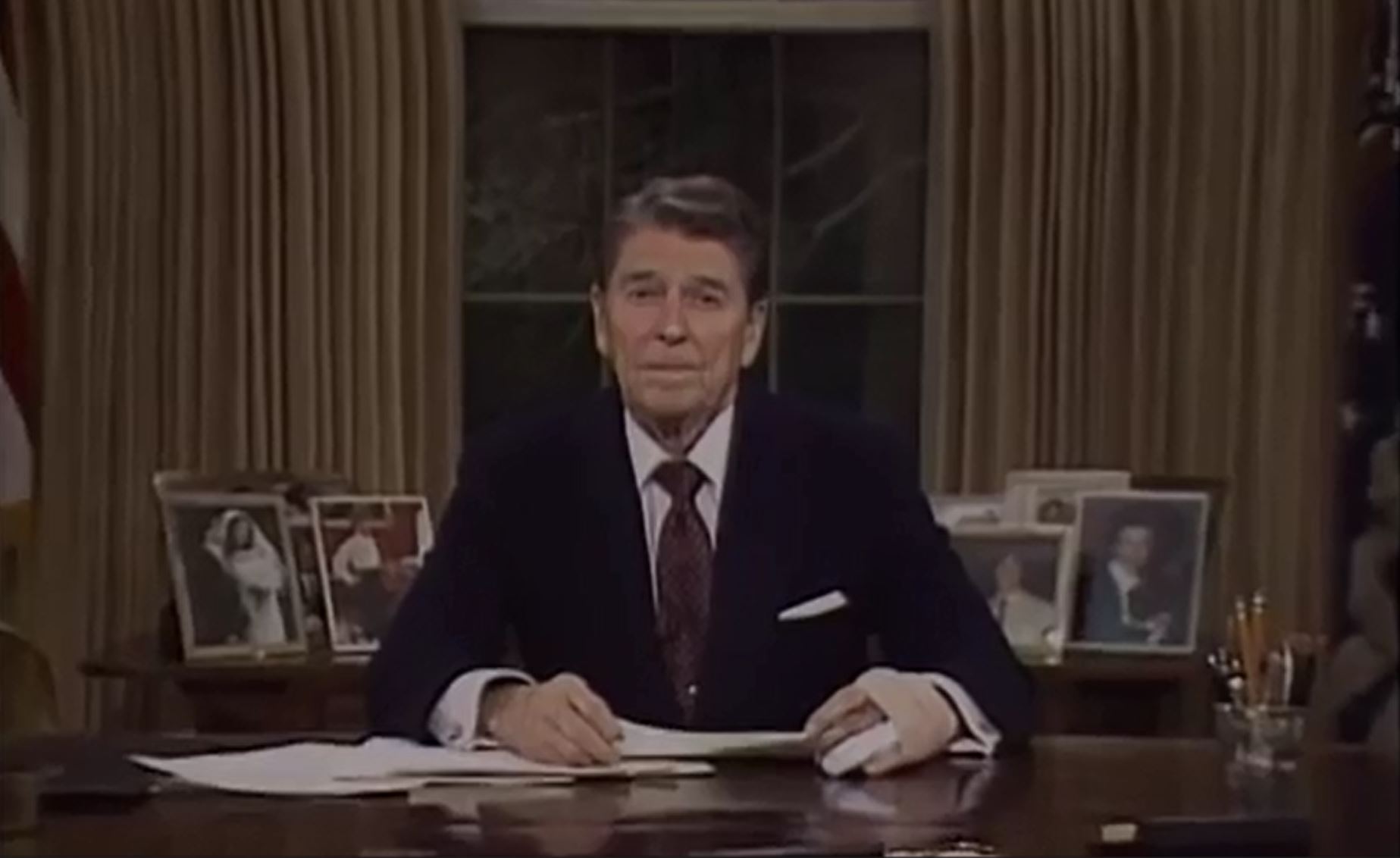
This is a Rhetorical Criticism essay which I wrote for my Rhetoric I class at Wittenberg Academy. Enjoy!
Karl Lunneborg
Rhetoric I – M25
Fr. Cain
17 November, 2025
Rhetorical Criticism Paper
Ronald Reagan, the United States’ fortieth president, was once nicknamed ‘The Great Communicator.’ In his Farewell Address he makes mention that he did not communicate greatly, but rather communicated great things. Today, however, I would like to prove him wrong. He fulfilled both tasks, communicating great things greatly. I will be looking at his Farewell Address, and piecing it out according to the classical understanding of Rhetoric. This includes arrangement and Aristotle’s Artistic Proofs, among others.
There are many different types of speeches, from persuasive speeches, to eulogies, to even gallows speeches. And in each one, there is a tradition from which you do not depart. This tradition, known as arrangement in classical Rhetoric, outlines what you say, and when, and with what tone. A farewell address is no different than the previously given examples. This speech is given after elections, in the final days of a president’s term. In general, the president will thank the American people, give a recount of what has gone on in the past term, give them direction and guidance for how to move forward, especially as another president comes into power, and finally leave them with a warning and a goodbye. Reagan followed this arrangement, and in the following paragraphs I will go into detail on these sections. For now, however, note that he does not disregard the tradition, but keeps it, even mentioning it later in his speech. This respect for tradition is my first reason that he is a great communicator.
Aristotle’s Artistic Proofs consist of Ethos, Pathos, and Logos. Ethos an appeal to morals, virtues, or personal credibility. Pathos is an appeal to emotions, and Logos is an appeal to reasoning. Reagan opens by greeting his fellow Americans, and mentions how this is his thirty fourth, and last, that he gives to them. His opening utilizes pathos, because he instills patriotism in his listener’s hearts. Pathos by itself is not a good argument, but when used with the other proofs, it makes a very strong argument. This speech in particular is not necessarily designed to make an argument, but things like pathos and ethos help tell the audience why they should be listening. The opening includes a thank you to the American people, for without them, nothing he did would have been possible. He continues, saying that “one of the things about the presidency is that you’re somewhat apart. You spend a lot of time going by too fast in a car someone else is driving, seeing the people through tinted glass. … a wave you see too late and can’t return. And so many times, I wanted to stop and reach out from behind the glass and connect. Well, maybe I can do a little of that tonight.” By these words, he at once apologizes to all the followers who he didn’t get a chance to recognize, and begins coming back down to the civilian level. As he stated, his life is far different from the life of the average civilian, yet he was going to again become an average civilian. So in this speech, he begins showing the people that he is returning to their level. As a communicator of many things, this desire for a connection with the people makes him great.
This recounting continues on, and makes up most of his speech. He tells a story of a sailor on the South China Sea, and refugees calling out “Hello, American sailor. Hello, freedom man.” He utilizes this story as more Pathos, bringing an American sense of pride. As he says, to be an American is to stand for freedom. He also supports this Pathos with a fact, for America was then once again respected in the world, and looked towards for leadership. Continuing, he says that that recovery of moral and the economic recovery were the two things he was most proud of. Again, Reagan utilizes a story to back up these accomplishments. Recounting how all the world leaders at an economic summit fell silent, and asked him to tell them about the American Miracle likewise helped instill patriotism. As mentioned earlier, Pathos by itself is not a good argument, but when used alongside other proofs, it makes a good argument.
As we have at this point seen a lot of Pathos and Logos, one might ask where the Ethos, or personal credibility lies. Reagan does not use his personal credibility as direct proof, but by these stories he recounts, he builds this up indirectly. He also gives a story of his experience in Russia, where the people were controlled from showing their support of Reagan. These personal stories from all around, on different subjects, with different people, all support Reagan’s Ethos, because any listener who thinks it through can tell that he knows what he’s talking about based on what he’s saying. He lived through a lot, and was learning all the time. He mentions that in his speech. “When you’ve got to the point when you can celebrate the anniversaries of your 39th birthday,” he says, “you can sit back sometimes, review your life, and see it flowing before you.” As everyone knows, with age comes wisdom, and this builds on his Ethos. His wisdom also contributes to his ability to communicate greatly.
Finally, we approach the section of the speech where he gives direction to the American people. He advises them to still “trust, but verify,” to “play, but cut the cards,” and says to watch carefully, and stay strong even if you see disfavorable things. There is a reason that the traditional arrangement puts direction here. After thanking the people, and recounting the deeds of the past term, enough has been said about what has happened, and the important thing is to know how to move on, even if the term had been a bad one. His terms were good ones, though, but it is likewise important not to dwell on the happiness of the past eight years, and instead focus on how to keep that good streak going in the future. Reagan continues giving direction, telling the people that “action is still needed. … Reagan’s regiments will have to become the Bush brigades. … he’ll need you every bit as much as I did.” The direction also gives the people courage, resolve, and purpose to keep fighting the same fights that Reagan sent them to do, even now that he has moved on. Yet again, we see that the traditional arrangement structures a speech well, and Reagan’s grasp of tradition helps make him a great communicator.
Now, we finally reach the penultimate section of Reagan’s Farewell Address, the warning. Reagan himself recognizes the tradition laid out in previous farewell addresses, as time after time, presidents leave the American people with a warning. He encourages them to keep up the ‘New Patriotic’ spirit, but also to bring it back into the culture. In his age, the sense of patriotism was all around, in the family, the neighborhood, schools, even movies and television. But he could tell that even though patriotism had been re-kindled, it still was not reestablished in the average community. This warning, as many do, comes with more direction. He directs the people to bring patriotism back to the general society.
Finally, he bids farewell. His final story is of John Winthrop and the ‘shining city on the hill.’ In this, he excellently ties parts back to his earlier stories, serving as an excellent conclusion. His final words are yet again directed specifically at the average citizens of America. “My friends: We did it. … We made the city stronger, we made the city freer, and we left her in good hands. All in all, not bad, not bad at all. And so, goodbye, God bless you, and God bless the United States of America.” This conclusion and farewell leaves the viewers with hope for the future of their country, while the directions from before still ring in their heads. As a communicator, one must be able to leave the audience with a final ‘hook,’ so to speak, that they will continue to remember even once the speech is finished. Reagan did a very good job of this, as with many other things.
In all, from this analysis of Ronald Reagan’s Farewell Address, we see that he is wrong when he says that he did not ‘communicate greatly.’ Reagan had respect for tradition, and abided by the traditions laid out before him in previous farewell addresses. He also has a great desire to connect with his listeners, making his communication skills all the better. His age came with wisdom, and he was learning in everything that he did. This wisdom helped him make good choices, choosing the right words for every situation, utilizing Ethos, Pathos, and Logos. Finally, he was able to leave the audience with final words that will stay in their heads even afterwards. From all of these points, one can see that Ronald Reagan was indeed the great communicator.
Bibliography
Reagan, Ronald; “Farewell Address” January 11, 1989. Master Tape #214. Courtesy Ronald Reagan Presidential Library.
Author Profile

Latest Posts
 TravelJanuary 10, 2026The Travel Times – VI; Texas Part Three: Amarillo, Cadillac Ranch, and the Big Texan
 PoetryDecember 28, 2025On Death
 PoetryDecember 27, 2025Homines Modernæ Ætatis
 EssaysDecember 8, 2025Rhetoric I Final Reflection Essay
No responses yet